



 Back to blogs
Mudras in Yoga: Understanding Their Meaning, Practice and Benefits


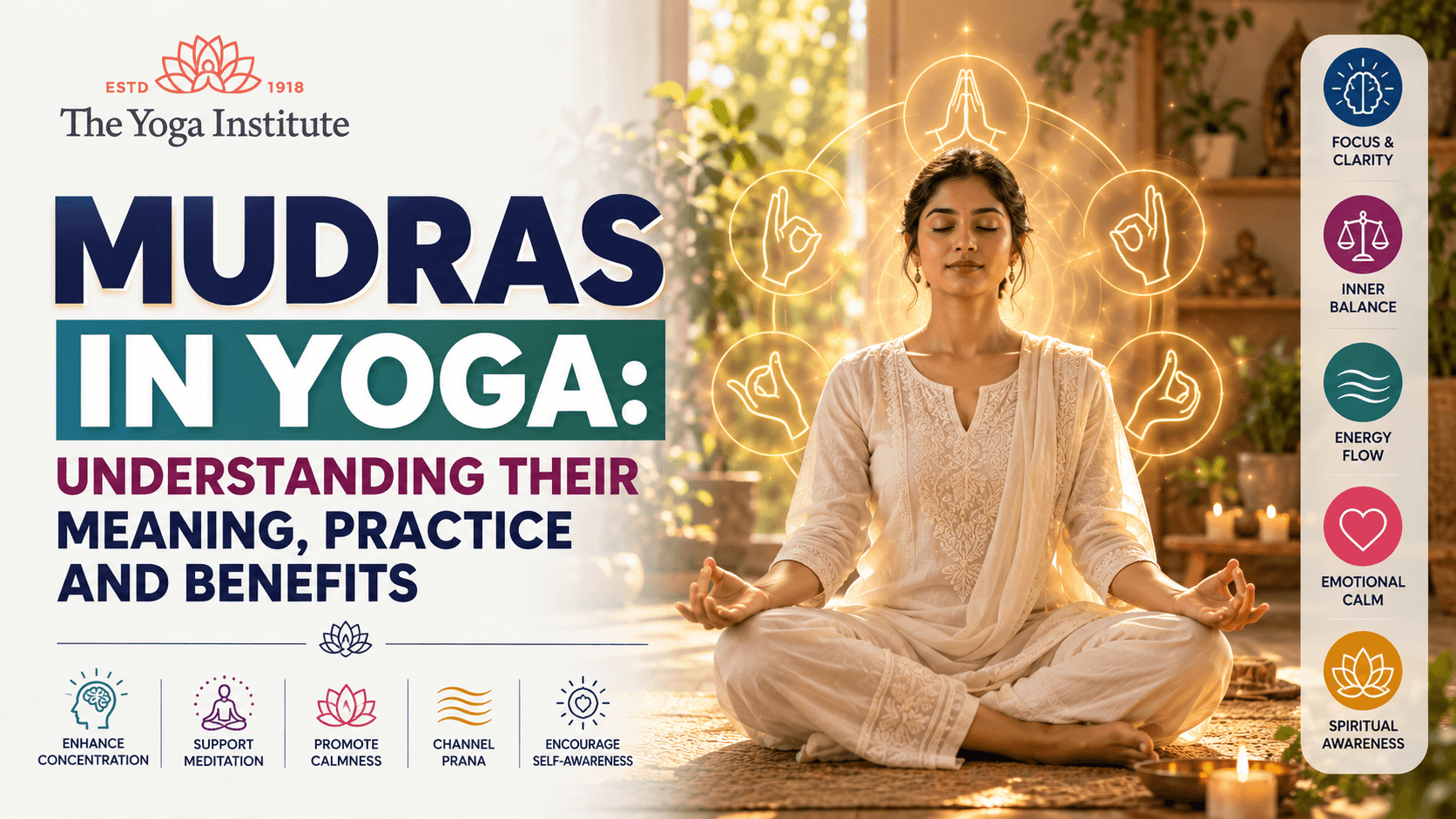
Have you ever noticed why your hands automatically come together when you pray? Or how you interlock your hands when you feel anxious?
Sometimes it rests simply on your lap when you are thinking about something.
We saw people doing meditation with their thumb and index finger slightly touching. Have you wondered why it is kept?or does this actually do anything?
Traditionally in yogic science and according to the ancient texts these Mudras, especially the Hand Mudras are used for different purposes including Meditation, concentration,and symbolic expression , balancing and directions of the Prana inside the body.
Here we discuss the important Mudras and their connection and significance according to the ancient yogic texts and try to understand them in this modern era.
What Are Mudras?
A Mudra is a sacred gesture or seal used in Yogic practices.These mudras or selas will help us to channelise the flow of Prana (Life Force). There are 3 types of Mudras Hasta Mudras (hand), Kaya Mudras (body) , Citta Mudras (consciousness)
Must Read: Yoga Mudras Explained
The Role of Mudras in Yogic Practice
The function of Mudras is to bring together and balance the body through the hands and as we have two hands on both the sides of the body which will help us to balance the Solar energy (Pingla) and lunar energy ( Ida).
For example: Gynan Mudra will connect the right solar prana through Pingla Nadi and left through Ida Nadi and it also stimulates both the energies.
And not only in balancing the energies in the body it is also used in mediation to improve focus and concentration which eventually help to direct our awareness inwards.
Mudras have traditionally been used along with meditation, pranayama, mantra, asana, and pratyahara.
Depending on the tradition, yoga mudras are used to:
● support meditation
● direct awareness
● represent philosophical ideas
● encourage stillness
● work with traditional concepts such as prana and subtle energy
Common Yoga Mudras
Gyan Mudra
Place the tip of your index finger lightly against the tip of your thumb. Keep the other three fingers relaxed.
Gyan means knowledge or wisdom and this mudra is traditionally associated with awareness and concentration.
Some traditional interpretations connect this mudra with subtle energy and higher awareness, but there is not enough clinical evidence to show that it directly changes pituitary or pineal gland function.
You can simply use the contact between the thumb and finger as a gentle sensory focus during meditation.
Chin Mudra
Chin Mudra is very similar to Gyan Mudra. The thumb and index finger gently touch while the other fingers remain relaxed.
Depending on the tradition, the position of the palms may differ.
Traditionally, Chin Mudra is associated with consciousness, awareness, and meditation.
It can be used as a simple hand mudra during breath awareness or quiet sitting.
Anjali Mudra
Anjali Mudra is the familiar prayer position.
Place both palms together comfortably in front of the chest and keep the shoulders relaxed.
Traditionally, this gesture may represent respect, gratitude, greeting, prayer, or inner peace.
It can also be a simple pause. Bring the hands together, notice your posture, observe a few natural breaths, and continue.
Prana Mudra
Place the tips of the ring finger and little finger against the thumb. Keep the index and middle fingers relaxed.
Traditionally, Prana Mudra is associated with prana or vital energy and is often linked with vitality.
Claims that it improves immunity, vision, vitamin deficiencies, or specific medical conditions have not been established by strong clinical evidence.
It can instead be used as a symbolic gesture during meditation or breath awareness.
Apana Mudra
Place the tips of the middle and ring fingers towards the thumb. Keep the index and little fingers relaxed.
Traditionally, Apana Mudra is associated with downward-moving prana and elimination.
This is a traditional energetic explanation. There is no strong evidence that this mudra detoxifies the body or treats digestive, reproductive, or urinary conditions.
Use it gently as part of meditation if it feels comfortable.
Vayu Mudra
Bend the index finger towards the base of the thumb and place the thumb gently over it. Keep the remaining fingers relaxed.
Traditionally, this mudra is associated with the air element and balancing vayu.
Claims that it can release trapped air or treat specific “vayu disorders” belong to traditional yogic understanding and are not established medical effects.
If you enjoy the gesture, use it as a meditative mudra.
Dhyana Mudra
Dhyana means meditation.
Place your hands comfortably in your lap, usually with one hand resting over the other and the palms facing upward.
Traditionally, this mudra represents meditation, peace, and focused awareness.
It is also practical because the hands remain supported in the lap, making it easier to sit still for longer.
How to Practice Hand Mudras
You do not need a complicated ritual to begin.
Choose one mudra and sit comfortably. You may sit on the floor in a meditative posture or use a firm chair.
Keep the body upright but relaxed.
Let the shoulders, jaw, face, wrists, and fingers soften.
Make the mudra gently. There is no need to press the fingers together strongly.
Keep your breathing natural unless you are practising a specific pranayama under appropriate guidance.
Choose one point of focus. This may be your breath, the feeling in your hands, a mantra, or your meditation practice.
When the mind wanders, simply notice it and return to your chosen focus.
If you feel pain, numbness, cramping, or discomfort in the hands, release the mudra.
How Long Should You Hold a Mudra?
There is no scientific evidence showing one universal amount of time needed for a mudra to work.
Traditional recommendations may suggest holding mudras for several minutes or longer, but these are not established clinical timings.
If you are a beginner, start with a few comfortable minutes during meditation.
If the hands stay relaxed and the position feels natural, you can gradually increase the time.
Consistency is more useful than forcing yourself to hold a mudra for a long period.
Mudras and Meditation
This is probably where mudras make the most practical sense.
During meditation, the mind naturally wanders. Keeping the hands in a stable position can reduce unnecessary movement and create a simple physical reminder to return to your practice.
The gesture itself does not need to stop your thoughts.
Instead, it can become part of the environment of meditation: still hands, relaxed shoulders, comfortable breathing, and a steady point of attention.
This fits with the broader meditation approach used at The Yoga Institute, where practitioners are encouraged to passively observe the breath and gently return their attention when the mind wanders.
There is more scientific evidence supporting meditation as a whole than specific mudras.
So rather than saying:
“This mudra reduces anxiety,”
it is more accurate to say:
“This mudra can be used as part of a meditation practice, and some forms of meditation may support stress management.”
That difference is important.
What Does Yoga Tradition Say About Mudras?
It is helpful to separate traditional yogic explanations from scientifically established health effects.
Yoga tradition may describe mudras through concepts such as prana, nadis, the five elements, pratyahara, concentration, and subtle energy.
These ideas are important within yogic philosophy, but they should not automatically be presented as measurable medical effects.
For example, The Yoga Institute describes Yogendra Yonimudra as a psycho-physical technique used to support pratyahara, or withdrawing attention from sensory stimuli.
Traditionally, different fingers and gestures may also carry symbolic or energetic meanings.
These meanings can have philosophical, spiritual, or personal importance to the practitioner, even when they are not supported by strong clinical evidence.
Mudras remind us that yoga does not always require big movements.
Sometimes a simple hand mudra, relaxed shoulders, natural breathing, and a few quiet moments are enough to bring your attention back to the present.
Traditional yoga gives these gestures deeper symbolic and energetic meanings, while modern evidence is more cautious about specific health claims.
You do not need to expect a yoga mudra to perform a miracle.
Let it simply become a small gesture that reminds you to pause, breathe, and return to yourself.
FAQs
1. What are mudras in yoga?
Mudras are symbolic gestures used in yoga. Many are hand mudras, although some traditions also use gestures involving the eyes, tongue, body, or breath. They are commonly used with meditation, pranayama, asana, and prayer.
2. What are the benefits of yoga mudras?
Yoga mudras may provide a stable hand position during meditation and can support focus, awareness, and relaxation. Traditional yoga gives additional energetic meanings to mudras, but specific medical benefits are not strongly established by scientific evidence.
3. What is the best mudra to use during meditation?
There is no single “best” mudra. Gyan Mudra, Chin Mudra, Dhyana Mudra, and Bhairava Mudra are commonly used. Choose one that feels comfortable and helps you stay focused.
4. How long should I hold a mudra?
There is no fixed time. Beginners can start with a few comfortable minutes and gradually increase the duration if the hands remain relaxed.
5. Can mudras cure diseases?
There is no strong scientific evidence showing that mudras can cure diseases. They should not replace medical treatment.
6. Can beginners practice yoga mudras?
Yes. Many hand mudras are simple. Sit comfortably, keep the hands relaxed, make the gesture gently, and breathe naturally.
7. Can I practice mudras every day?
Yes. Simple mudras can be included in a daily yoga or meditation routine. Practising one or two regularly may be easier than constantly changing techniques.
8. Do mudras control energy in the body?
Traditional yoga links mudras with prana or subtle energy. Modern science has not confirmed that specific finger positions control measurable biological energy.




0 Comments
No comments yet. Be the first to comment!