



 Back to blogs
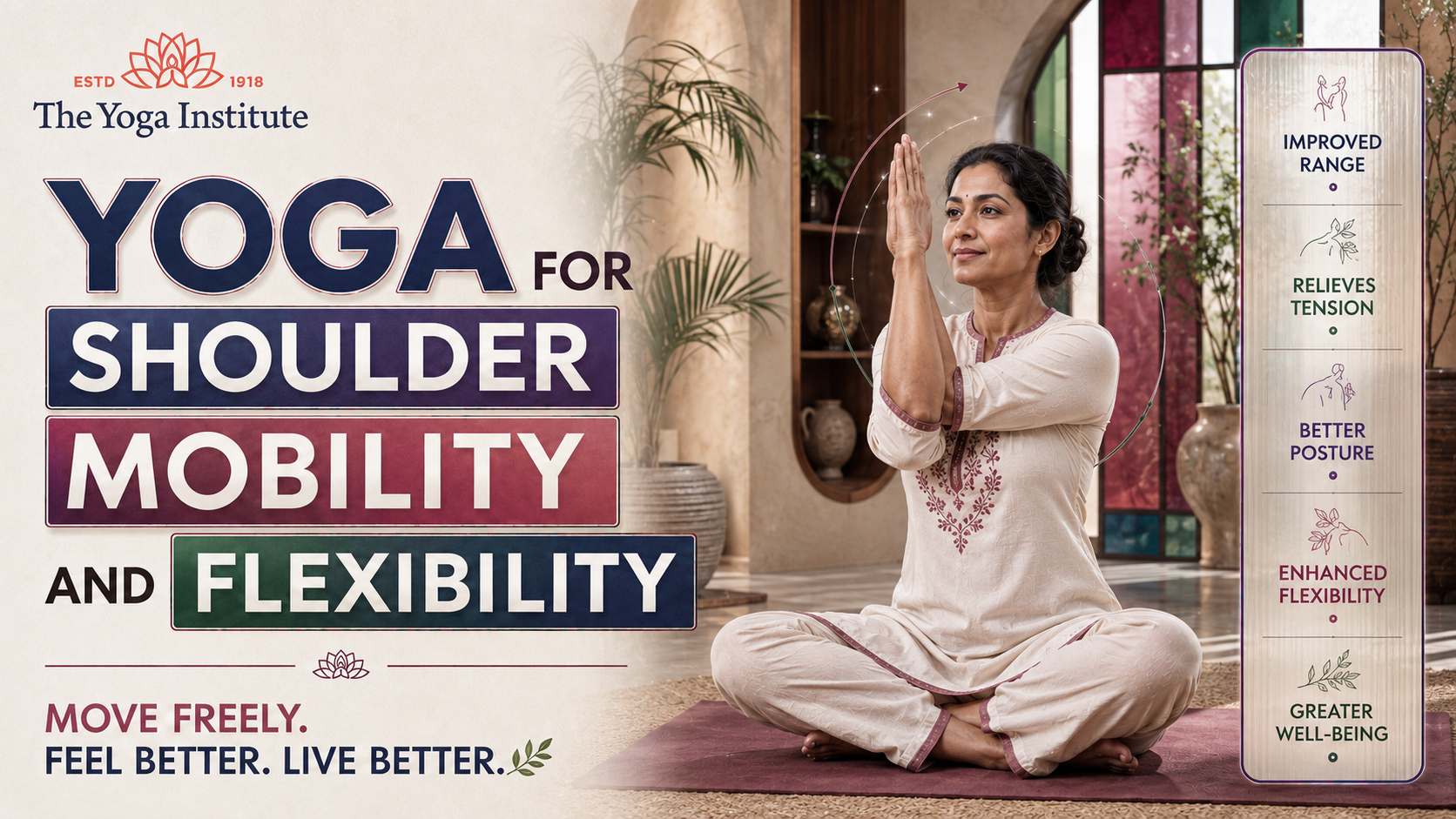
Yoga for Shoulder Mobility: Gentle Poses to Improve Movement and Flexibility


Yoga for Shoulder Mobility: Gentle Poses to Improve Movement and Flexibility
ou reach for something on the top shelf and suddenly realise your arm does not go up quite as easily as it used to. Or perhaps, after a few hours at your desk, your shoulders feel heavy, tight and almost permanently drawn towards your ears.
Shoulder stiffness can quietly become part of everyday life. Reaching overhead, putting on clothes, carrying a bag or even sitting comfortably may begin to feel restricted.
Yoga for shoulder mobility offers a gentle way to bring movement back into this area. Through controlled arm movements, spinal mobility, posture awareness and gradual stretching, yoga can help you explore a more comfortable range of motion without turning every stretch into a test of flexibility.
The idea is simple: move slowly, breathe comfortably, observe what you feel and never force the range.
What Causes Limited Shoulder Mobility?
Shoulder movement can become restricted for many reasons.
Long hours at a desk or laptop may leave the upper body in the same position for much of the day. Frequent phone use can encourage a rounded posture. Repetitive activities may also make certain movement patterns feel easier than others.
Sometimes, we simply stop taking our arms through their natural range. Reaching overhead, opening the chest or moving the shoulder blades gradually becomes less familiar.
Previous injuries, arthritis and painful shoulder conditions can also affect movement. In these situations, trying to “stretch through” stiffness may not be appropriate.
It is useful to remember that stiffness is not always a sign that the shoulder needs a stronger stretch. Sometimes it simply needs regular, comfortable movement performed with greater awareness.
Mobility vs Flexibility in the Shoulders
Mobility and flexibility are closely related, but they are not exactly the same.
● Flexibility generally refers to how comfortably muscles and surrounding tissues can lengthen.
● Mobility is about how freely and comfortably you can move through an available range.
For example, pulling your arm farther overhead does not automatically mean your shoulder has better mobility. If you have to shrug excessively, strain the neck or force the movement, the extra range may not be particularly useful.
This is why shoulder mobility yoga should not focus only on stretching deeper.
A better approach is to combine:
comfortable range + controlled movement + breathing + posture awareness.
Over time, this can make movement feel smoother and more natural.
How Yoga Supports Shoulder Movement?
Yoga gives you an opportunity to notice movements that are often ignored during the day.
When you slowly raise your arms, you can observe whether one side feels different from the other. When you move through Cat–Cow, you can notice the movement of the upper back and shoulder blades. When the arms travel behind the body, you can recognise where comfortable movement ends and strain begins.
The breath also gives you a useful reference point.
If you can move while breathing naturally, the practice is more likely to remain comfortable. If you find yourself holding your breath while trying to reach farther, it may be a sign that you are trying too hard.
For yoga for stiff shoulders, keep the approach simple:
Move slowly → breathe comfortably → observe sensations → adjust as needed.
You do not have to achieve the maximum possible range in every movement.
Best Yoga Poses for Shoulder Mobility
These practices introduce the shoulders to different movement patterns without making the session unnecessarily intense.
A Short Daily Shoulder Mobility Routine
A shoulder routine does not have to be long to be useful.
Begin with Talasana II for 2 slow rounds to introduce upward arm movement. Follow with Talasana III for another 2 rounds so the shoulders move through a slightly different pathway.
Then practise Marjaryasana–Bitilasana for 8–10 slow rounds. Instead of concentrating only on the spine, notice how the upper back and shoulder blades respond as you move.
If appropriate for you, follow with a comfortable round of Parvatasana. Keep the upward reach controlled and avoid forcing the arms beside the ears.
Next, practise Yogamudra for up to 2 gentle rounds. Move slowly and keep the position behind the back comfortable.
Finish in Balasana for several relaxed breaths.
The sequence can be remembered simply as:
Lift → open → mobilise → lengthen → release → rest.
You do not need to complete every movement every day. If a particular direction feels uncomfortable, reduce the range or leave that practice out.
Regular, comfortable movement is more important than completing a perfect sequence.
1. Yogendra Talasana II - (Palm Tree Pose Variation)
A standing upward stretch that coordinates arm movement with the breath and encourages length through the upper body.
Steps
1. Stand erect with your feet comfortably placed and your hands beside the body.
2. Keep your spine upright and gaze straight ahead.
3. Begin inhaling slowly.
4. Raise both arms overhead in a smooth, controlled movement.
5. At the same time, gradually rise onto your toes and stretch the body upwards.
6. Keep the shoulders as relaxed as possible while reaching upward.
7. Stay briefly without straining.
8. Exhale and slowly lower your heels while bringing the arms back down.
9. Repeat for 2 comfortable rounds.
Benefits
● Encourages upward movement of the arms and shoulders.
● Provides a lengthening stretch through the body and spine.
● Encourages opening through the chest and ribcage.
● Helps coordinate movement with breathing.
● Develops awareness of the shoulder range during overhead movement.
Contraindications / Limitations
● Do not force the arms into a fully overhead position if the shoulders feel restricted.
● Reduce the range if there is pain or significant discomfort.
● Keep the movement controlled rather than swinging the arms.
● Stop the practice if raising the arms increases shoulder pain.
2. Yogendra Talasana III - (Palm Tree Pose Variation)
A variation of Talasana that takes the arms outward and upward, encouraging movement through the shoulders and chest.
Steps
1. Stand erect with your arms relaxed beside the body.
2. Keep the spine upright and gaze forward.
3. Begin inhaling slowly.
4. Raise both arms outward from the sides and gradually take them overhead.
5. Bring the palms towards each other only as far as comfortable.
6. Simultaneously rise onto your toes and stretch the body upwards.
7. Notice the movement through the shoulders, upper chest and sides of the body.
8. Exhale slowly as you lower the heels and bring the arms back down.
9. Repeat for 2 comfortable rounds.
Benefits
● Encourages a broad range of shoulder movement.
● Provides an upward stretch through the body.
● Opens the chest and ribcage.
● Provides a gentle stretch through the pectoral region.
● Develops coordination between breathing and movement.
Contraindications / Limitations
● Do not force the palms to meet overhead.
● Reduce the arm range if shoulder movement feels restricted.
● Avoid rushing or jerking the arms upward.
● Stop if the posture produces pain rather than a comfortable stretch.
3. Yogendra Parvatasana - (Mountain Pose)
A seated upward stretch that encourages length through the spine while bringing awareness to the shoulders and arms.
Steps
1. Sit comfortably in Padmasana or Sukhasana.
2. Keep the spine erect, shoulders relaxed and chin comfortably drawn in.
3. Allow the hands to rest beside you initially.
4. Inhale and slowly raise both arms outward from the sides.
5. Continue lifting the arms into an upward stretch.
6. Bring the palms together overhead only if this is comfortable.
7. Keep the arms close to the ears without forcing the shoulders.
8. Maintain the upward stretch briefly according to your comfort.
9. Turn the palms outward and slowly lower the arms as you exhale.
10. Relax before repeating.
Benefits
● Provides an upward stretch through the spine and upper body.
● Engages the shoulder flexors during overhead movement.
● Encourages postural awareness.
● Helps develop steadiness and control during movement.
● Encourages coordination between posture and breathing.
Contraindications / Limitations
● The Institute's standardised guidance lists frozen shoulder and arthritis among the limitations for Parvatasana.
● People with spinal injury or spinal abnormalities should avoid unsupervised practice.
● Do not force the arms beside the ears if shoulder mobility is limited.
● Reduce or stop the posture if overhead movement causes pain.
4. Yogendra Marjaryasana–Bitilasana -(Cat–Cow Pose)
A gentle spinal movement that also encourages movement and awareness around the upper back and shoulder blades.
Steps
1. Come onto your hands and knees.
2. Keep your hands below the shoulders and knees below the hips.
3. Keep the starting position comfortable and stable.
4. Inhale and gently lift the chest and tailbone while looking slightly upward.
5. Allow the upper back and shoulder-blade region to move naturally with the spine.
6. Exhale and slowly round the back.
7. Bring the chin towards the chest without forcing the neck.
8. Continue moving slowly between the two positions.
9. Repeat for 8–10 rounds while breathing smoothly.
Benefits
● Improves spinal mobility.
● Encourages movement through the upper back.
● Reduces stiffness associated with prolonged sitting.
● Encourages smooth movement around the shoulder-blade region.
● Improves body and movement awareness.
Contraindications / Limitations
● Practise carefully if recovering from a recent spinal injury.
● Avoid exaggerated arching or rounding.
● Keep the movement within a comfortable range.
● Stop if the movement causes pain.
5. Yogendra Yogamudra - (Yoga Mudra)
A seated forward-bending practice that introduces gentle movement through the back and shoulder region while encouraging breath awareness.
Steps
1. Sit in a comfortable seated position.
2. Keep the spine erect and the shoulders relaxed.
3. Take both hands behind your back.
4. Hold the opposite wrist comfortably.
5. Take a slow, comfortable inhalation.
6. As you exhale, gently bend forward from the hips.
7. Allow the head to move towards the floor only as far as comfortable.
8. Do not pull the arms backwards or strain the neck and shoulders.
9. Remain for a few comfortable breaths.
10. Inhale and slowly return to the upright position.
11. Practise up to 2 comfortable rounds.
Benefits
● Provides a stretch through the back and shoulder region.
● Encourages awareness of the shoulders when the arms move behind the body.
● Helps coordinate forward movement with breathing.
● Encourages body awareness during a controlled stretch.
● Provides an opportunity to notice differences between comfortable movement and strain.
Contraindications / Limitations
● Do not strain the neck or shoulders.
● Do not force the hands farther behind the back.
● If holding the opposite wrist is uncomfortable, avoid forcing the position.
● Stop if the posture causes shoulder pain or significant discomfort.
6. Yogendra Balasana -(Child's Pose)
A restful forward-folding posture that allows the body to settle after more active shoulder and spinal movements.
Steps
1. Kneel comfortably with your knees together or slightly apart.
2. Slowly move your hips towards your heels.
3. Fold your torso forward.
4. Rest your forehead on the floor or on a suitable support.
5. Position your arms comfortably without forcing the shoulders.
6. Allow the shoulders, neck and back to soften.
7. Breathe naturally.
8. Remain for several comfortable breaths.
9. Slowly return to an upright position.
Benefits
● Encourages physical relaxation.
● Gently releases tension through the back.
● Promotes body awareness.
● Provides a quiet transition after active movement.
● Gives the shoulders an opportunity to relax after mobility practice.
Contraindications / Limitations
● Modify the posture if you have knee, hip or ankle discomfort.
● Avoid forcing the hips towards the heels.
● Position the arms wherever the shoulders feel comfortable.
● Come out of the posture if it creates significant discomfort.
Common Mistakes to Avoid
Trying to Stretch as Far as Possible
Shoulder mobility is not a competition.
A deeper stretch is not automatically a better stretch. If reaching farther makes you tense the neck, hold your breath or force the joint, reduce the range.
Shrugging the Shoulders During Every Overhead Movement
When the arms travel upwards, notice whether the shoulders immediately become tense.
Instead of trying to push the arms higher, explore a range in which the movement remains controlled and relatively comfortable.
Moving Too Quickly
Fast repetitions can make it difficult to notice what the shoulder is actually doing.
Slower movement gives you time to observe stiffness, differences between the two sides and unnecessary tension.
Ignoring the Upper Back
The shoulders do not move in isolation.
Practices such as Marjaryasana–Bitilasana encourage movement through the spine and upper back, which makes them useful additions to a shoulder-focused routine.
Holding the Breath
If you are holding your breath simply to maintain a stretch, reduce the effort.
Let breathing remain smooth and comfortable throughout the practice.
Practising Through Pain
A stretching sensation and pain are not the same thing.
Pain, increasing discomfort or a feeling that something is wrong is a reason to stop or modify the movement rather than push farther.
Expecting Immediate Results
One session may make the shoulders feel pleasantly mobile, but lasting change usually depends on consistency.
A few minutes of comfortable movement practised regularly may be more sustainable than an occasional aggressive stretching session.
Shoulder mobility rarely needs dramatic solutions. Sometimes, it begins with simply lifting your arms slowly, allowing the upper back to move, noticing where you are holding tension, and giving your shoulders a few minutes of attention each day.
That is what yoga for shoulder mobility can offer not a demand to become more flexible overnight, but a regular opportunity to move with greater awareness.
Some days, your arms may travel a little farther. On other days, the range may feel smaller. Neither experience needs to become a struggle.
Practise gently. Breathe naturally. Listen closely. Your body does not need to be forced into mobility—it needs to be given the space to move.
Because true mobility is not about how impressive a stretch looks. It is about making everyday movements feel a little easier, a little freer, and a little more natural.
At The Yoga Institute, yoga is approached not simply as a collection of poses, but as a way to understand your body and build a more mindful relationship with movement one practice at a time.
FAQs
1. Can yoga improve shoulder mobility?
Yoga may support shoulder mobility through gradual, controlled movement, stretching, posture awareness and greater awareness of how the shoulders move. Practices such as Talasana and suitable variations of Parvatasana introduce overhead movement, while Marjaryasana–Bitilasana encourages mobility through the spine and upper back.
2. Why are my shoulders so stiff?
Shoulder stiffness may develop after prolonged periods in the same position, limited movement, repetitive activities or habitual posture. Painful or persistent stiffness may have other causes and should not automatically be treated by stretching more intensely.
3. What are the best yoga poses for shoulders?
Institute-based practices that can be incorporated into yoga for shoulder mobility include Talasana variations, Parvatasana, Marjaryasana–Bitilasana and Yogamudra. Balasana can provide a restful transition after more active movements. The most appropriate pose depends on your individual comfort and any existing shoulder condition.
4. Can yoga help desk-related shoulder tension?
Gentle movement may help after spending long periods sitting or working in one position. Talasana and Marjaryasana–Bitilasana can introduce movement through the arms, shoulders, spine and upper back. Regular movement breaks during the day are also preferable to waiting until the shoulders feel extremely stiff.
5. Should I do yoga with shoulder pain?
Do not force yoga poses through shoulder pain. If pain is persistent, worsening, follows an injury or significantly restricts normal movement, seek appropriate professional advice. If you have an existing shoulder condition, practise only movements that have been considered suitable for you.
Want to improve your mobility naturally?
Start your yoga journey with The Yoga Institute and discover mindful, balanced movement.


About Author



0 Comments
No comments yet. Be the first to comment!